
Our Therapy
Inspire® therapy enables patients to breathe regularly so they can sleep soundly.
Inspire® Therapy Works Inside The Body
During a short and safe outpatient procedure,1* the Inspire® implant is placed in the body through two small incisions. After the procedure, patients work with their provider to fine tune their therapy settings and learn how to use to the Inspire™ remote to turn the therapy on and off. Once activated, Inspire® therapy syncs with patients’ breathing during sleep, and uses gentle pulses to move their tongue out of the airway so they can breathe regularly and sleep soundly.
Prep
The Inspire® implant procedure is a short and safe outpatient procedure in which patients are placed under general anesthesia.
Incision 1
The first incision is made under the patient’s chin where the nerve controlling their tongue is located. A small cuff is placed on this nerve.
Incision 2
The second incision is made in the upper chest where the implant is placed.
Recovery
After the procedure, patients can expect some discomfort and swelling for a few days, but can resume more strenuous activities within a few weeks.
* As with any surgically implanted device, there are risks associated with the Inspire system. Results may vary. See safety information at inspiresleep.com/safety.
1 Suurna MV, Steffen A, Boon M, et al. Impact of Body Mass Index and Discomfort on Upper Airway Stimulation: ADHERE Registry 2020 Update. Laryngoscope 2021; 131(11): 2616-2624
Many of your patients may be eligible for Inspire® therapy
Learn more about eligibility and contraindications.


More than 100,000 people with obstructive sleep apnea have pursued restful sleep with Inspire® therapy.
79% Reduction In Sleep Apnea Events1
Broadly Covered By Insurance2
90% Patient Satisfaction2
1 Woodson BT, Strohl KP, Soose RJ, et al. Upper Airway Stimulation for Obstructive Sleep Apnea: 5-Year Outcomes. Otolaryngology Head Neck Surgery 2018; 159(1):194-202)
2 Data on file.
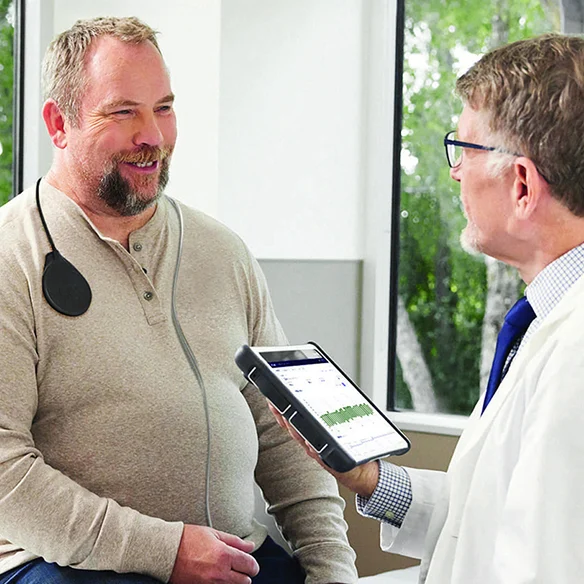
Living With Inspire® Therapy
About a month after the procedure, patients have a follow-up appointment with a sleep physician to activate the Inspire® implant and learn how to use their Inspire™ remote. After a few months of use, patients have a follow-up sleep study to ensure their sleep goals are being met. Once all is confirmed, patients will have check-ins with their sleep physician every 6-12 months at physician discretion.
Stimulation Therapy for Apnea Reduction (STAR) clinical trial outcomes1*
The Stimulation Therapy for Apnea Reduction (STAR) clinical trial began in 2010 at 22 leading medical centers across the United States and Europe. One-year STAR Trial outcome measures were published in the January 9, 2014 version of the New England Journal of Medicine.
Results showed that sleep apnea patients receiving Inspire® implant experienced significant reductions in sleep apnea events and significant improvements in quality of life measures.
The significant improvements and reductions measured after 1-year were sustained over a 5-year follow-up period. The outcomes include:
79% reduction in AHI events
Significant improvements in daytime functioning as measured by FOSQ score2
Significant reductions in daytime sleepiness2
90% of bed partners reported soft or no snoring for their partner, as compared to only 17% of bed partners at baseline3
* Sponsored by Inspire Medical Systems, Inc.
1 Data on file.
2 Strollo, P.J., et. al., Upper-Airway Stimulation for Obstructive Sleep Apnea N Engl J Med 2014; 370:139-149
3 Woodson BT, Strohl KP, Soose RJ, et al. Upper Airway Stimulation for Obstructive Sleep Apnea: 5-Year Outcomes. Otolaryngology Head Neck Surgery 2018; 159(1):194-202)
Imaging With Inspire® Therapy
It’s important to understand what model of the Inspire® implant your patient has, because different models have different imaging guidelines.
It is important to note that all Inspire® therapy patients are eligible to have CT scans, X-rays and ultrasound images taken anywhere in the body.
You have several options to determine what type of Inspire Generator Model is implanted in your patient:
Look at the Patient’s ID Card
Examine the patient’s medical records
Identify through X-ray
There is a YELLOW MR TRIANGLE on the back of the Patient ID Card if your patient has the Inspire implant Generator Model 3028 or Model 3150. If so, they are eligible for full body MRI scans provided specific guidelines are followed.
If your patient has the Inspire® implant Generator Model 3024, they are not eligible for MRI scans. However, they are eligible to have CT scans, X-Rays and ultrasound images taken anywhere in the body.
Inspire SleepSync™ Patient Management Platform
The Inspire SleepSync™ platform is a connected patient management system designed to improve the Inspire® therapy experience for patients and providers. The Inspire SleepSync™ platform enables wireless and automatic implant monitoring, efficient care coordination, and dynamic patient engagement.


How to add Inspire® therapy into your practice
It’s easy to get started—talk with an Inspire® therapy expert and they’ll explain the training process. Once you’ve received your Inspire® therapy training, you’ll be able to offer your CPAP-intolerant patients another option to help treat their OSA.
Inspire is not for everyone. Talk to your doctor (or Talk to your patients) about risks, benefits and expectations associated with Inspire. Risks associated with the surgical implant procedure may include infection and temporary tongue weakness. In rare cases tongue paresis and atrophy may occur. Some patients may require post implant adjustments to the system’s settings in order to improve effectiveness and ease any initial discomfort they may experience. Important safety information and product manuals can be found at inspiresleep.com/safety-information, or call 1-844-OSA-HELP.